Machine Learning-Based Estimation of Photovoltaic System Capacity for Industrial Power Applications
Keywords:
Photovoltaic system, machine learning, solar energy prediction, random forest, energy demand estimation, meteorological dataAbstract
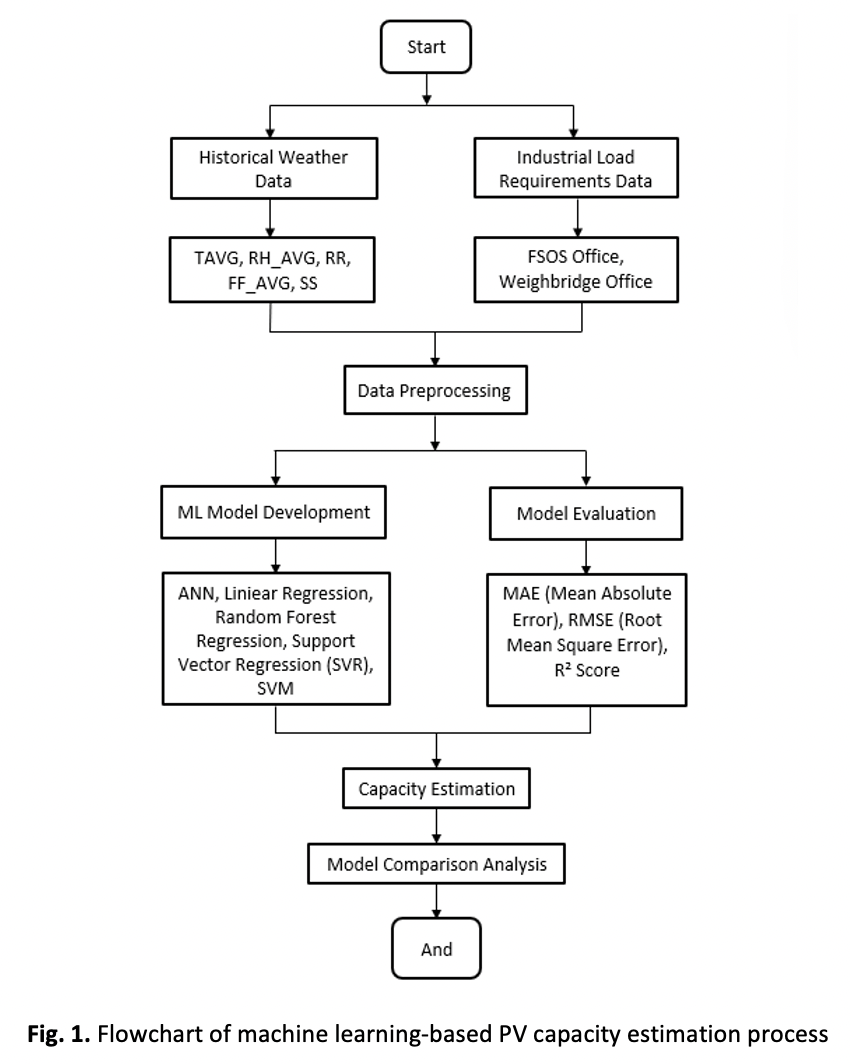
The increasing demand for electrical energy in the industrial sector has encouraged the adoption of renewable energy systems, particularly photovoltaic (PV) technology, to reduce dependence on conventional power sources. However, the variability and non-linear characteristics of meteorological parameters pose significant challenges in accurately predicting solar energy production. This study aims to develop a data-driven approach to estimate photovoltaic system capacity for industrial applications based on weather data and energy demand. A comparative machine learning framework is implemented using Artificial Neural Networks (ANN), Linear Regression, Random Forest Regression, Support Vector Regression (SVR), and Support Vector Machine (SVM). The models are trained using 730 days of historical meteorological data, including temperature, humidity, rainfall, wind speed, and sunshine duration. Model performance is evaluated using Mean Absolute Error (MAE), Root Mean Square Error (RMSE), and the coefficient of determination (R²). The results indicate that the Random Forest model achieves the best performance, with an R² value of 0.9621 and the lowest prediction errors. The predicted daily energy demand of 455.79 kWh is used to estimate the required PV system capacity, demonstrating the effectiveness of the proposed approach. In conclusion, machine learning-based modeling provides an accurate and reliable method for photovoltaic capacity planning, supporting efficient and sustainable energy management in industrial systems.